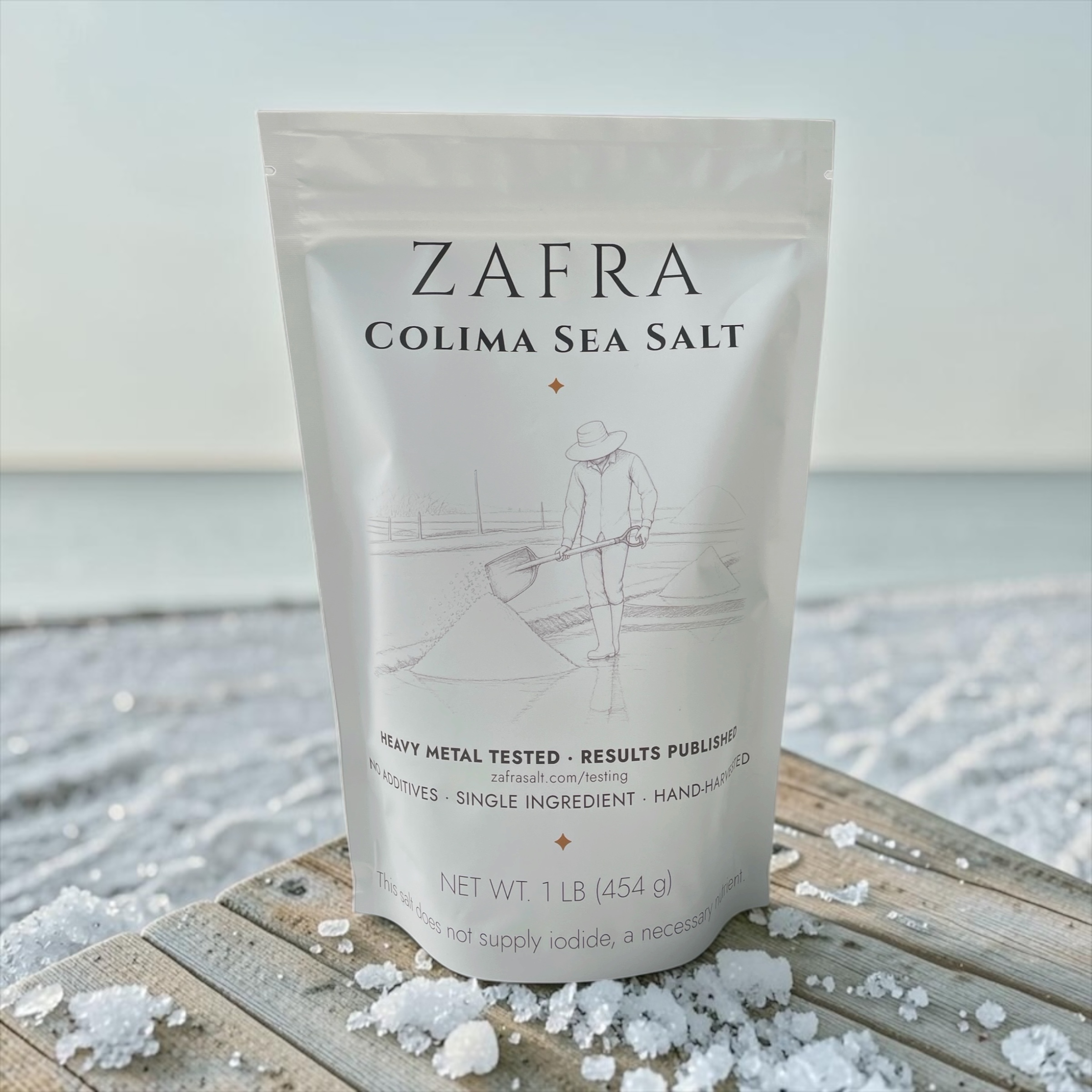
In pre-Hispanic times, the king of Colima sent this salt to the Aztec emperor — carried over mountains on foot. That lagoon still exists. The salt still comes from there.
Centuries ago, Colima's salt traveled over 300 miles to reach the Aztec emperor — a tribute so prized that kingdoms fought to possess it.
That lagoon still exists. The salt still comes from there.
Laguna de Cuyutlán sits on Mexico's Pacific coast, worked by the Sociedad Cooperativa de Salineros de Colima — a cooperative of 192 members established in 1925 — whose families have harvested this lagoon for generations. Every year, when the rains dry and the lagoon settles, the zafra begins.
Zafra is an independent Mexican sea salt brand built by Made by Hand LLC, based in Edinburg, Texas. One ingredient. One lagoon. One unbroken tradition. Product of Mexico — Colima.
Through traditional wells, the salineros draw brine to the surface from a subsoil of mineral-rich earth and volcanic sand — nature's own filter. The brine is then laid into shallow clay-lined beds where the Pacific sun and coastal wind slowly evaporate it, until only salt remains.
Drawn from beneath a protected lagoon, not the open ocean.
Naturally filtered through black volcanic sand, trapping what doesn't belong.
Every batch is independently tested for heavy metals (lead, arsenic, cadmium, mercury).
You may notice natural moisture or tiny flecks of volcanic sand. These aren't flaws — they're proof of origin.
Every batch of Zafra is independently tested by a certified third-party laboratory. Results are published here — not just claimed.
Hand-harvested from Laguna de Cuyutlán, Colima, Mexico.
You may notice natural moisture and tiny flecks of black volcanic sand — both signs of a truly unrefined salt. Pinch by hand, don't shake.
Notify Me When Available
Still made by hand. Still filtered by the Earth itself. Still proof, not promises.
Salt has been made this way for centuries. We think that's worth keeping exactly as it is. Most of the world's salt is now mined or industrially processed — what happens at Laguna de Cuyutlán is increasingly rare.
Every bag of Zafra helps keep it that way.You're on the list. We'll let you know when Zafra is available.
Yes. Every batch is independently tested for heavy metals — arsenic, cadmium, mercury, and lead — by SGS México, an EMA-accredited laboratory. Results are published in full at zafrasalt.com/testing. Our lead result is 0.05 mg/kg, twenty times below the EU's legal maximum for food-grade salt.
No. Single ingredient: sea salt. No anti-caking agents, no iodine added, no bleaching, no flow agents. What comes out of Laguna de Cuyutlán is what goes in the bag.
Laguna de Cuyutlán, on Mexico's Pacific coast in the state of Colima. The salt is produced by the Sociedad Cooperativa de Salineros de Colima, a cooperative established in 1925 whose members have worked the same lagoon for generations.
Salineros draw brine from traditional wells sunk into the subsoil beneath the lagoon — not from the open ocean. The brine is laid into shallow clay-lined beds where the Pacific sun and coastal wind evaporate it slowly, until only salt remains. It is then harvested by hand.
Most commercial sea salt comes from open ocean evaporation or underground mining. Colima salt is drawn from subsoil brine beneath a protected coastal lagoon, naturally filtered through mineral-rich earth and volcanic sand before it ever reaches the surface. The process hasn't changed in centuries.
A small, naturally occurring amount — 0.05 mg/kg (50 ppb). Lead is present in the earth's crust and measurable at trace levels in virtually every sea salt on the market. A result of zero typically means the lab's detection limit was reached, not that lead is truly absent. Our result is twenty times below the EU legal maximum for food-grade salt and at the low end of published sea salt data.
An accredited third-party laboratory — not us — analyzed the salt for arsenic, cadmium, mercury, and lead using ICP-MS, the gold standard method for trace metal detection. The lab's full report, including sample ID, lot number, method, and detection limits, is available for download at zafrasalt.com/testing.
Salt is a mineral, not an agricultural product, so USDA Organic certification does not apply to sea salt. Zafra is unrefined, additive-free, and produced without synthetic inputs — but we do not use the word "organic" because it has a specific legal meaning that doesn't apply here.
Yes. The cooperative holds OU Kosher certification.
Zafra launches soon on Amazon US. Sign up at zafrasalt.com to be notified the moment it's live.